UVWORKS | Major New Regulation Released! WS/T 10050-2026 New UV Disinfection Standard Issued, Ushering in a New Era of Standardization for the UV Disinfection Industry
Why UVC‑LED Deep UV Disinfection Technology Has Become a New Industry Benchmark
Water is the source of life, and safe drinking water is closely linked to public health. With rising health awareness, people’s requirements for drinking water have shifted from “clean and impurity‑free” to “sterile, fresh, residue‑free and healthier”.
Traditional water treatment mainly adopts chemical disinfection and mercury lamp UV disinfection. However, both solutions have inherent drawbacks. Chemical disinfection easily leaves residues and disinfection by‑products that endanger human health. Conventional mercury lamps suffer from mercury pollution, short service life, slow startup and high energy consumption, failing to meet the trends of lightweight, eco‑friendly and intelligent equipment.
Against this backdrop, UVC‑LED deep ultraviolet physical disinfection technology features safety, environmental protection, high efficiency and zero residues. It is gradually replacing traditional disinfection methods and widely used in household water purification, commercial drinking water, mobile water supply and circulating water treatment. Combining authoritative scientific principles, prevailing industry standards and measured data, this document objectively analyzes the core value and application advantages of UVC‑LED disinfection technology.
1. Scientific Principle: Core Mechanism of UVC Deep UV Disinfection
Natural ultraviolet rays are divided into UVA, UVB and UVC with distinct functions. Not all ultraviolet light can sterilize.
Authoritative microbiological research proves that only short‑wave UVC deep ultraviolet within 200–280 nm can effectively inactivate bacteria, viruses, algae and fungi. The 265 nm band is the peak nucleic acid absorption wavelength of microorganisms with optimal disinfection performance; the 275 nm band balances disinfection efficiency and component stability, widely adopted for civil and commercial disinfection equipment.
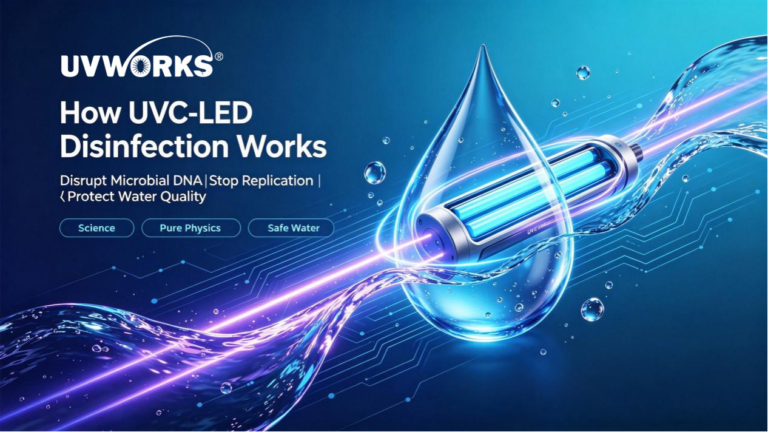
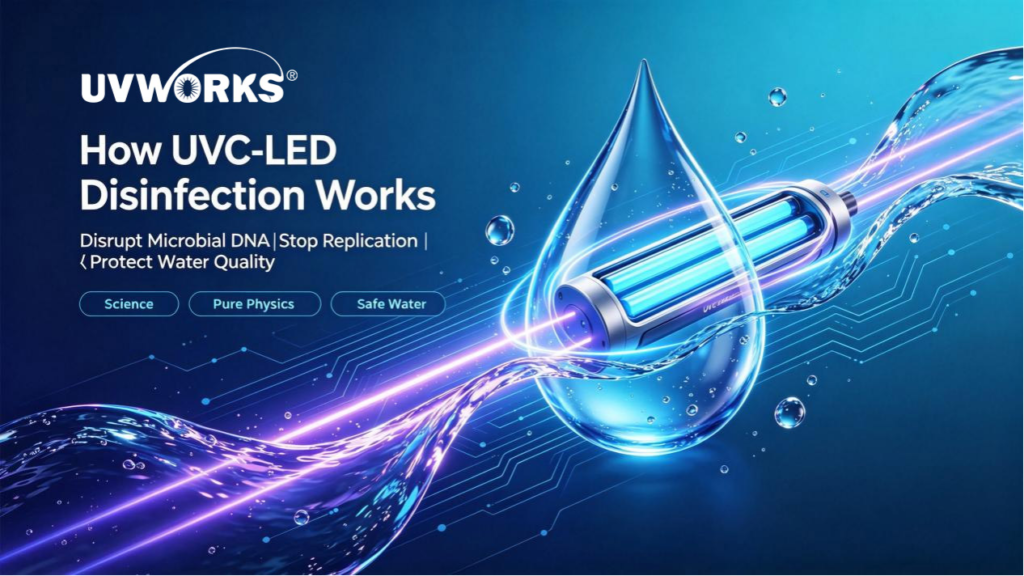
UVC‑LED disinfection adopts pure physical mechanism: deep UV photons penetrate microbial cell membranes and damage DNA/RNA of bacteria and viruses by forming thymine dimers, blocking microbial replication and proliferation to realize rapid inactivation.
No chemical agents are required in the whole process. It produces no disinfection by‑products, leaves zero residues and causes no secondary pollution, complying with standards for healthy drinking water and green water treatment.
Important Reminder: UVC in sunlight is completely blocked by the atmosphere. Daily sunlight exposure, ordinary blue light and UVA light cannot achieve effective sterilization. Please avoid conceptual confusion.
2. Technical Comparison: UVC‑LED Disinfection vs. Traditional Mercury Lamp Disinfection
Low‑pressure mercury lamps have long been mainstream UV disinfection equipment for water treatment, yet they have inherent limitations. As a new generation semiconductor light source, UVC‑LED solves the pain points of conventional technology.
- Safe & Eco‑friendly, Zero Mercury Pollution
Traditional mercury lamps contain liquid mercury. Broken tubes easily lead to mercury leakage and environmental pollution with high waste disposal costs, failing to meet RoHS standards. UVC‑LED is a solid‑state semiconductor light source free of mercury and heavy metals, simple to dispose and environmentally safe. - Instant Startup with Strong Adaptability
Mercury lamps require preheating and cannot work instantly. Frequent startup and shutdown drastically shorten service life. UVC‑LED needs no preheating, supports automatic on/off linked to water flow with zero standby power consumption, suitable for scenarios with frequent switching. - Compact Size, Modular & Easy Integration
Mercury lamp devices are bulky and difficult to embed into small water purifiers and embedded terminals. UVC‑LED disinfection modules feature lightweight and miniaturized design, which can be flexibly integrated into water purifiers, pipeline dispensers, vehicle water tanks, ice makers, circulating water equipment and other products. - No Ozone Generation to Prevent Pipeline Corrosion
Traditional short‑wave UV mercury lamps generate ozone during operation, which irritates the respiratory tract and corrodes pipelines. Our 265/275 nm UVC‑LED has a wavelength longer than 243 nm and cannot crack oxygen to produce ozone, enabling safer operation and lower equipment wear. - Wide Low‑Voltage Compatibility for Versatile Scenarios
UVC‑LED supports DC 12–24V wide voltage input, compatible with household mains, vehicle power supply and photovoltaic power supply, applicable to both fixed and mobile water supply equipment.
Objective Note: Under equal power consumption, single LED irradiation intensity is slightly lower than high‑power mercury lamps. Through optimized optical structure, modular array layout and precise control of water optical path, disinfection dosage can reach industry standards to satisfy various application demands.
3. Verified Test Data: Industry Standard for 99.99% Disinfection Rate
Many disinfection devices mark a “99.99% sterilization rate”, corresponding to ≥4 log microbial inactivation value specified in industry standards, a high threshold for civil and commercial water purification equipment.
It should be clarified that disinfection performance depends not only on light sources, but also on water turbidity, water flow speed and equipment cleanliness — a widely recognized technical limitation. UVC disinfection is recommended to be equipped with a pre‑filter system to remove impurities and suspended solids and prevent UV shielding.
Measured Test Data of Our Products
Our self‑developed UVC‑LED water disinfection modules have passed authoritative third‑party microbial testing. Under standard working conditions, the modules achieve a stable 99.99% disinfection rate against common pathogenic bacteria in drinking water including E. coli, Pseudomonas aeruginosa and Staphylococcus aureus. They effectively eliminate harmful microorganisms, continuously inhibit biofilm and algae growth, and resolve secondary pollution at the rear end of water purification equipment.
The product adopts IP68 waterproof structure and high‑transmittance quartz packaging with excellent sealing, water resistance and corrosion resistance. It runs stably for flowing water and static water storage, featuring long service life and low maintenance cost.
4. Wide Application Scenarios of UVC‑LED Disinfection
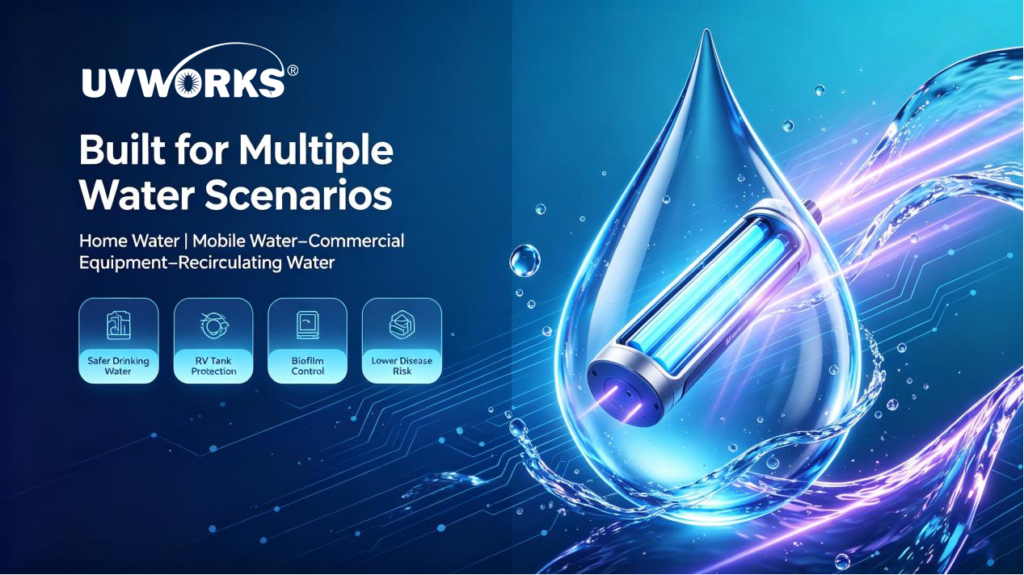
With diversified adaptability, our UVC‑LED disinfection modules serve various water purification and water treatment scenarios:
- Household Water Purification Terminals
Compatible with RO water purifiers, pipeline dispensers and smart water fountains to realize end‑point disinfection at water outlets. It solves secondary pollution caused by bacteria breeding in pipelines and water tanks after filtration, retains beneficial minerals without chemical residues, ideal for daily household and maternal‑infant drinking water. - Mobile Water Supply Scenarios
Suitable for water storage equipment on RVs, yachts and outdoor camping. Mobile water supply environments cannot frequently replace water sources or add disinfectants. Low‑voltage UVC‑LED modules provide continuous automatic bacteriostasis to guarantee safe outdoor water use. - Commercial Water‑Related Equipment
Applied in commercial ice makers, coffee machines, humidifiers and public water dispensers to solve biofilm accumulation and peculiar odors in closed water tanks, suitable for office buildings, shopping malls, hotels and other public areas. - Circulating Water Treatment Scenarios
Applicable to industrial aquaculture circulating water and small industrial circulating water treatment. It precisely inactivates harmful bacteria and algae without chemical disinfectants, protects beneficial flora in water and reduces aquaculture diseases and equipment contamination.
5. Rational Understanding: Clarify Technical Boundaries of UVC‑LED Disinfection
Every technology has applicable boundaries. Objective understanding helps maximize technical value and avoid misleading promotion:
- UVC ultraviolet light has weak penetration. It can only kill microorganisms within direct irradiation range and cannot penetrate sediment and suspended impurities. It cannot replace pre‑filter systems and must be used together with filtering equipment.
- Integrated enclosed waterway modules have no UV leakage risk and are safe to use. Open UV light sources require proper protection to avoid direct exposure to human skin and eyes.
- Light sources suffer natural light attenuation. Regular inspection and maintenance are required to maintain qualified disinfection dosage.
- The core function of this technology is water disinfection and bacteriostasis. It cannot remove dissolved pollutants such as heavy metals and residual chlorine. It serves as a core disinfection unit instead of a complete water treatment solution.
6. Conclusion
Driven by the industry trend of environmental compliance and health priority, chemical disinfection is gradually phased out and traditional mercury lamps are being eliminated. Pure physical, residue‑free and eco‑friendly UVC‑LED deep UV disinfection technology has become an essential upgrade solution for the water treatment industry.
We have long been engaged in R&D and manufacturing of UVC‑LED disinfection modules, focusing on diversified water disinfection scenarios. We can provide standard disinfection modules and customized optical solutions according to customers’ actual water flow, installation space and power supply mode, helping water purification and water treatment enterprises upgrade products and build core competitiveness.
220nm 222nm 230nm 235nm 240nm 245nm 250nm 255nm 260nm 265nm 270nm 275nm 280nm 280nm 290nm 295nm 300nm 305nm 308nm 310nm 315nm 320nm 330nm 335nm 340nm 365nm 395nm 405nm smd3535 3535led 3535 uv led smd6868 6868 Ied 6868 uv Ied TO39 TO46 UVWORKS UVWORKS uvcworks uvc works UVA Led UVB Led UVC Led UVSensor UV Sensor Uvdetector UV detector